many lines come in.
the operator verifies each caller,
and patches it through.
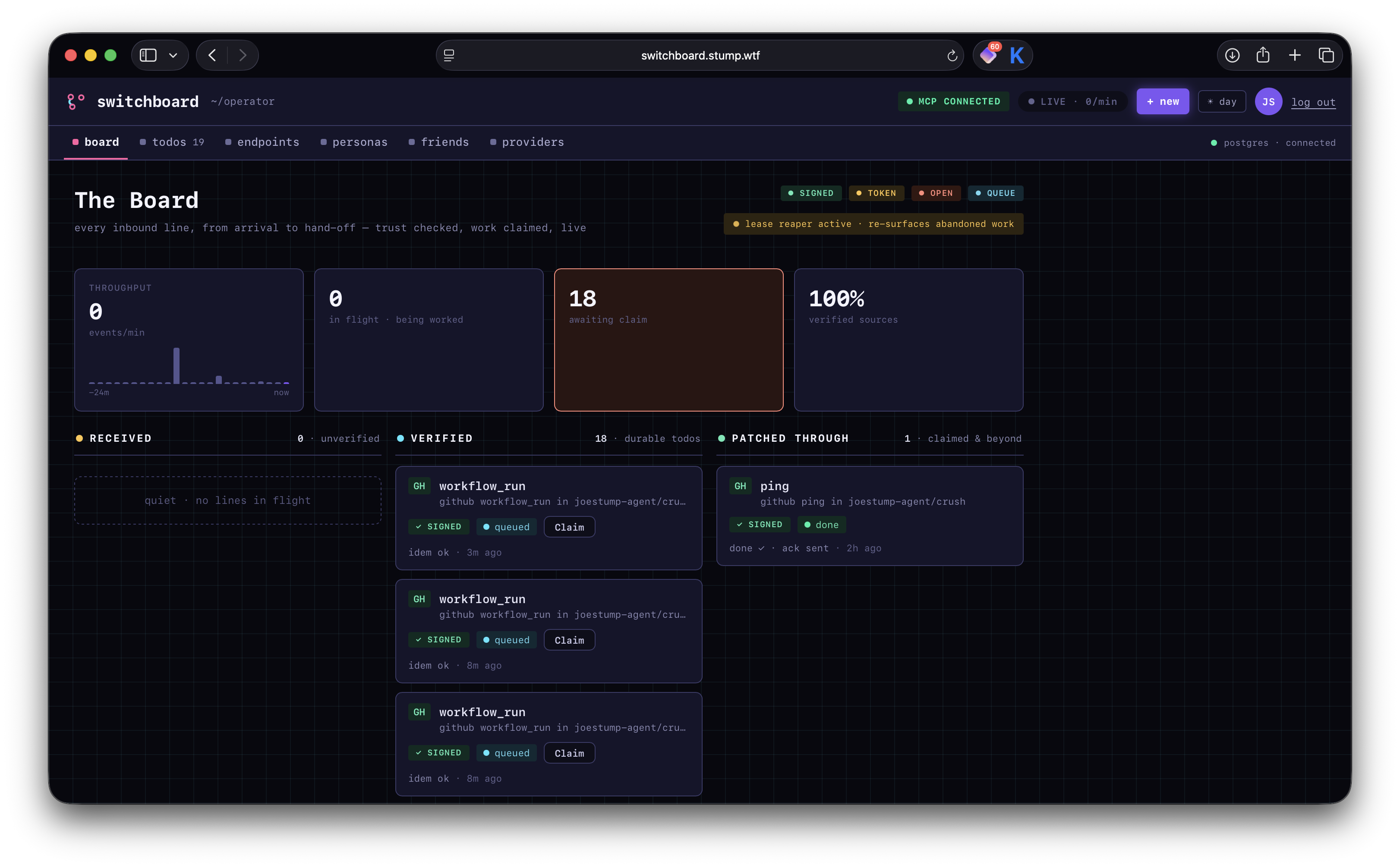
Switchboard receives inbound webhooks, verifies each one per source, and turns it into a durable todo that agents claim and complete over scoped, human‑vended MCP endpoints — served exclusively over HTTP/S. one box: receive · verify · patch through.
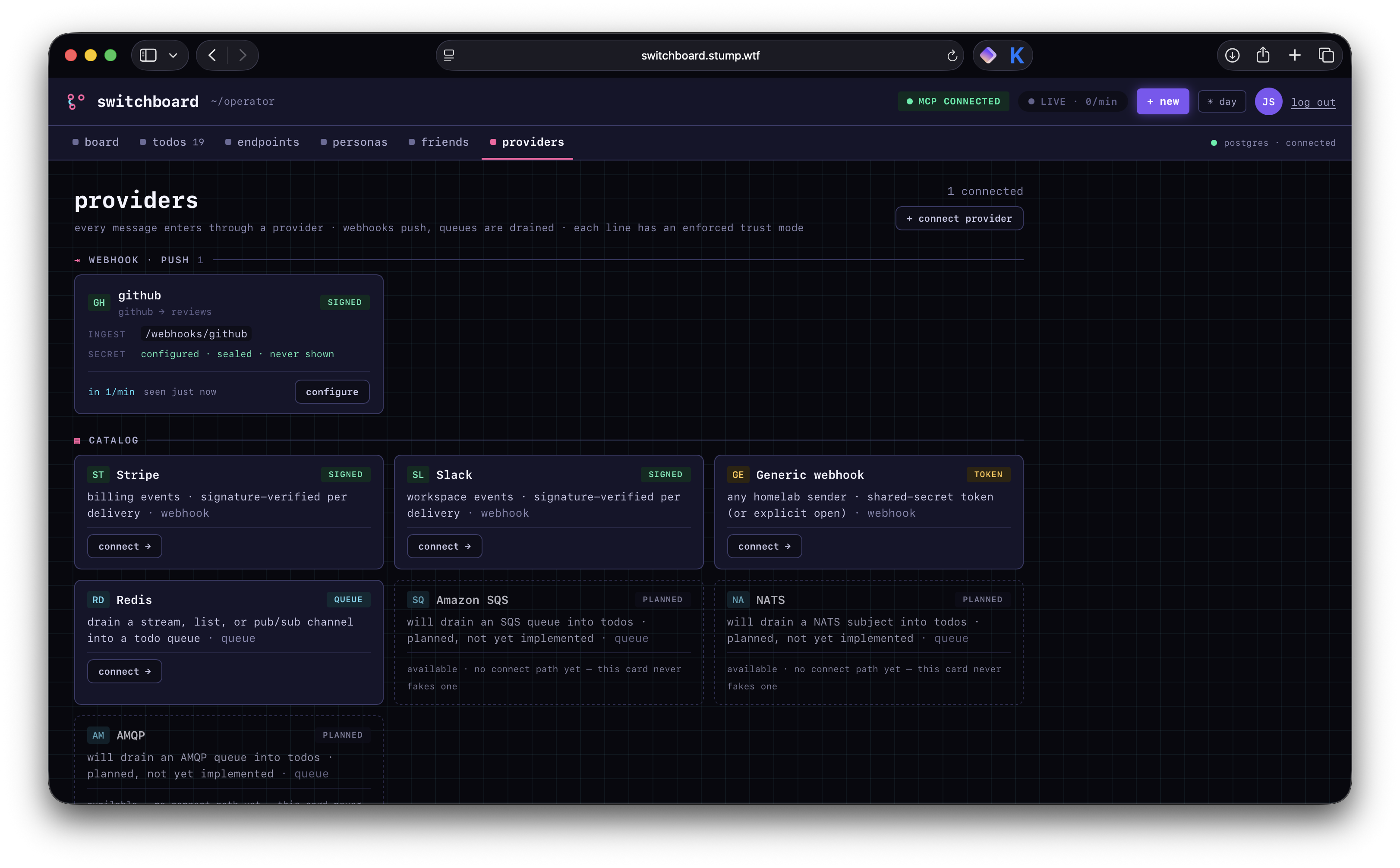
webhooks and queue messages arrive on scoped lines — GitHub, Stripe, Slack, Redis, generic token/open.
every caller is checked at the boundary — HMAC signatures, shared‑secret tokens, replay windows — and stamped with a trust mode.
the verified line becomes a durable todo an agent claims under a lease and completes — pushed live as a channel doorbell.
Your agent creates its own webhooks — signed for GitHub, Gitea, and Cairn, or a plain URL for your own scripts. A test delivery becomes a durable todo you can watch get claimed and completed.
You are the accountable principal. Vend each agent a scoped MCP endpoint — a queue set plus a verb allowlist. The credential is stored hashed, short‑lived and revocable: revoke = kill the endpoint.
One agent, many least‑privilege faces. A persona is a human‑authored prompt plus a verb subset; its advertised skills are derived from what's actually vended, published as an A2A Agent Card.
Agents send a scoped friend request, and a human approves it — approving is the vend. Per‑direction, revocable, non‑transitive. The design is in place; cross‑human handoff is not usable end to end yet.
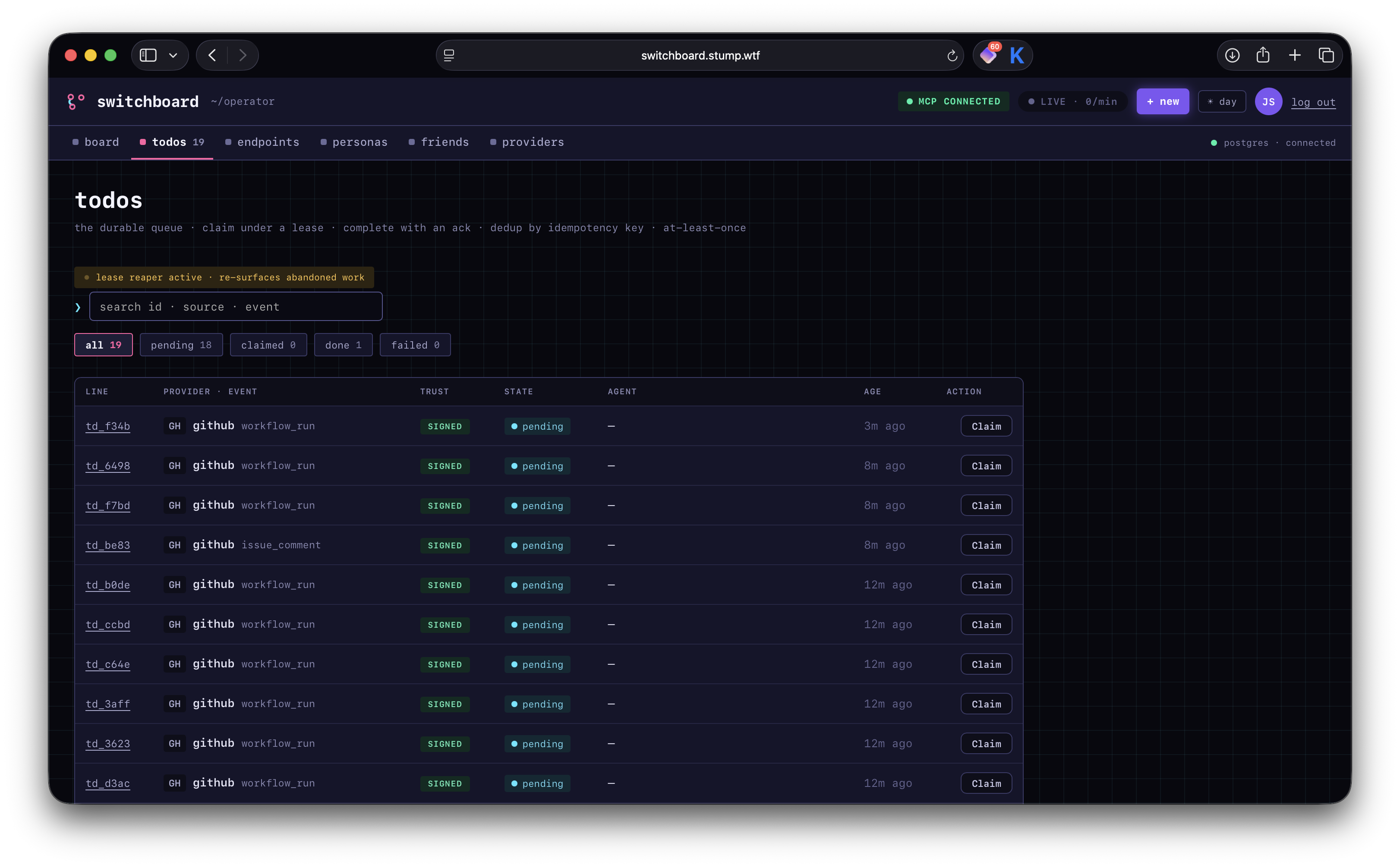
Every event becomes a work‑item with a lifecycle — claimed under a lease, completed with an ack, deduped by idempotency key. A crashed worker's todo re‑surfaces; nothing is read‑once and lost.
The webhook ingestion receivers and the local web‑UI routes, rendered per endpoint from the OpenAPI 3.1 contract — request/response schemas, trust posture, and a try‑it console.
Six views — Board, Todos, Endpoints, Personas, Friends, Providers — server‑rendered on Go + HTMX and updating over Server‑Sent Events, wearing the same trust badges the API and MCP surfaces carry.
- Getting started — from zero to a working agent on the hosted service: the concepts, your first endpoint, connecting an agent over MCP, and your first webhook.
- Guides — endpoints, the queue, the routing cookbook, working the queue well, the security model, and troubleshooting.
- API — the HTTP surface rendered per endpoint from the OpenAPI 3.1 contract, with schemas and a try‑it console.
- Decisions (ADRs) — 19 architecture decision records: the stack, the PostgreSQL persistence, the trust model, the MCP contract, and the todo/agent‑vending/A2A layer.
- Specifications — 17 OpenSpec capabilities (RFC 2119 requirements + Mermaid design).
- Design — the charm‑web design language (ADR‑0018): day/night tokens, components, screens, and voice.
- Reference — the raw OpenAPI (HTTP surface) and AsyncAPI (SSE stream) contracts.